
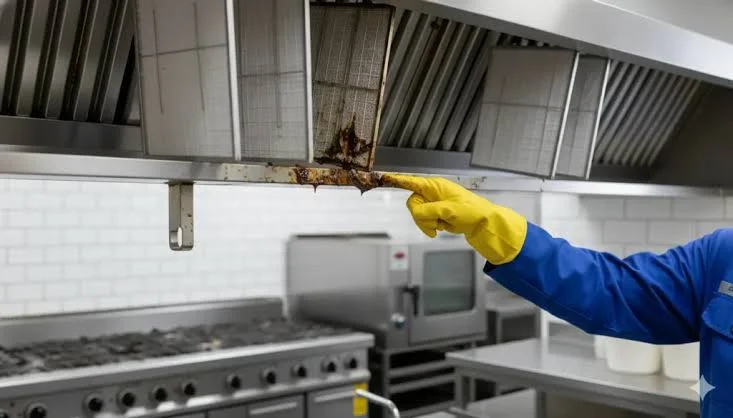
How often should a commercial kitchen hood be cleaned? Every month to every year, depending on your cooking: monthly for solid-fuel cooking, every 3 months for high-volume kitchens, every 6 months for moderate-volume kitchens, and every 12 months for low-volume kitchens. These are NFPA 96 minimums, and your local fire marshal can require a shorter interval when grease buildup is heavy.
Decision rule: if your kitchen fits more than one row, follow the shortest interval.
In this guide: the NFPA 96 schedule, what decides your interval, signs your hood needs cleaning sooner, how to build your schedule, what a full cleaning includes, Florida fire code, what happens when a cleaning is overdue, and answers to common questions.
NFPA 96 is the national standard for ventilation control and fire protection of commercial cooking operations. The NFPA 96 hood cleaning frequency table follows one simple principle: the more grease your cooking sends into the exhaust system, the more often that system must be cleaned. These intervals are minimums. They show the longest a kitchen should go between cleanings, not a target to stretch. The standard also requires the system to be inspected for grease buildup and cleaned whenever the buildup demands it, even if the next scheduled date has not arrived.
A professional exhaust hood cleaning covers the whole exhaust path, not just the visible hood. Grease does not stay where you can see it. It travels with the hot air into the ductwork and up to the rooftop fan, and it collects there out of sight.
Three things decide where your kitchen falls in the table: your fuel, your menu, and your hours. Solid-fuel cooking with wood or charcoal produces the heaviest grease load, which is why it sits on a monthly interval. High-volume cooking such as charbroiling, wok cooking, and round-the-clock service comes next, because the exhaust system rarely gets a break. A typical full-service restaurant with moderate volume usually lands on a six-month interval, while a seasonal or low-volume kitchen can go up to a year.
So when owners ask how often should a commercial kitchen hood be cleaned, the useful answer is never a single date. It is a schedule matched to your kitchen: your fuel, your menu, and your hours. A kitchen that fries all day and a kitchen that mostly steams vegetables do not carry the same fire risk, and the standard treats them differently. If your menu or your hours change, your interval should change with them.
Volume is not only about the size of the room. A small kitchen running a charbroiler all day can send more grease into its exhaust system than a large kitchen that plates mostly oven work. What matters is how much grease leaves the cooking surface and enters the hood. That is why two restaurants on the same street can sit on different intervals, and why a busy season, a new menu, or extended hours are all good reasons to review your schedule rather than assume last year’s interval still fits.
The calendar is a guide, not a guarantee. Check for these signs between scheduled visits, and book a cleaning early if any of them appear:
Do not wait for the next scheduled date if these signs show up. Grease that has already collected is fuel, and the longer it sits in ductwork, the harder it is to remove. An early cleaning is a small job. An overdue one rarely is.
Setting your schedule takes four simple steps. First, find your last service report and note the date and what was cleaned. Second, match your cooking to the table above and pick your interval. Third, book the next visit before that interval ends, not after. Fourth, keep every report on file where an inspector can see it. A schedule written down is far easier to keep than one remembered, and it is the first thing an inspector asks about.
A complete service cleans the entire exhaust path from the cooking surface to the outside air. That means the hood canopy, the filters removed and degreased, the plenum behind the filters, the duct runs, the rooftop exhaust fan, and grease containment on the roof. It should end with a written service report showing the date, the company, and the areas cleaned.

A cleaning that stops at the filters is incomplete, because grease in the ductwork and the fan is just as much a fire hazard as grease in the hood. When you compare providers, ask exactly which parts of the system their service covers. Your grease trap cleaning runs on a separate schedule, but the same habit applies: book it before it is overdue, not after.
Florida’s fire code adopts NFPA 96 by reference, which means the schedule in this guide is the schedule Florida inspectors work from. Enforcement sits with your local fire marshal, the authority having jurisdiction for your area. That marshal can require cleaning more often than the table minimum if an inspection finds heavy buildup, and local rules can add their own requirements on top of the standard.
For a Florida restaurant owner, the practical point is simple: know your interval, keep your reports, and never let a cleaning slide past its date. An inspector who finds a clean system and a tidy file of reports has little to question. An inspector who finds heavy grease and no recent report has a problem to act on.
An overdue cleaning can turn into a failed inspection, and a failed inspection can turn into an order to stop cooking until the system is cleaned. That is lost service during the busiest part of your day. It can also cause trouble with an insurance claim after a fire, since insurers look at maintenance records when they assess what happened. On top of that, heavy buildup is harder and slower to remove, and it strains the exhaust fan, which has to work harder to pull air through a greasy system.
None of this is meant to alarm you. It is the reason the schedule exists. Regular cleaning keeps the risk small, the cost predictable, and the kitchen open. A fan motor working against a greasy system also wears faster, and ductwork that has not been cleaned in years takes far longer to bring back to a clean state than ductwork on a regular schedule. Staying on schedule is usually the cheaper and simpler path in every direction.
Yes. Your local fire marshal is the authority having jurisdiction, and that office can require a shorter interval than the table minimum when an inspection finds heavy buildup or a higher-risk setup. The table is the floor, not the ceiling.
Yes. Even a kitchen that cooks lightly still sends some grease into the exhaust system, and a year is a long time for it to collect unseen. The annual interval is the minimum for the lightest cooking operations, and it still applies.
A complete service does. The hood, filters, plenum, duct runs, and rooftop fan form one exhaust path, and grease collects along all of it. If a quote covers only the visible hood, it is not a complete cleaning.
Keep the written service report for every visit, showing the date, the company name, and the areas cleaned. File the reports where your fire inspector and your insurer can see them. Good records are the simplest proof that your kitchen is maintained.
Staff can run filters through the dishwasher or degrease them regularly, wipe accessible hood surfaces, and watch for the warning signs listed above. That daily care helps, but it does not replace professional cleaning of the ductwork and fan, which need proper equipment and access.
A standard single-hood restaurant system usually takes two to four hours. Larger kitchens with several hoods, long duct runs, or heavy buildup take longer. Most providers schedule the work overnight or between shifts, so the kitchen is ready for the morning shift without losing service time.
So, how often should a commercial kitchen hood be cleaned? As often as your cooking demands, and never less often than the NFPA 96 schedule for your kitchen type. Find your interval in the table above, book the next visit before it ends, and keep the report on file. That routine is what keeps a kitchen open, safe, and ready for any inspection.
If your kitchen is due for cleaning, or you are not sure which interval fits your cooking, Florida Kitchen Pros can help. Call (727) 507-1735 or request a free quote.
That routine is what keeps a kitchen open, safe, and ready for any inspection.