

A grease-saturated filter pulled from a working exhaust hood. Filters are the first thing a professional crew removes and deep cleans.
Is your exhaust system overdue for a cleaning? Florida Kitchen Pros deep cleans the full exhaust system, hood, ducts, and fan, for commercial kitchens across Florida. One call and your system is degreased, safe, and inspection-ready.
By Florida Kitchen Pros · Updated October 2026
The short answer: Professional exhaust system cleaning covers the full grease path, from the cooking line to the rooftop: the crew shuts down and protects the kitchen, deep cleans the filters, scrapes the hood and plenum, cleans the full duct run, services the fan, then rinses, polishes, and reassembles. Wiping the visible hood is only a fraction of the job. The dangerous grease sits where you cannot see it: inside the ducts and the fan.
In This Guide
Quick Facts
Many people picture someone wiping the stainless hood over the cook line. That hood is only the visible front door. The exhaust system is the full path carrying heat, smoke, and grease-laden vapor from the cooking surface to the outside of the building. It has five parts, and a proper cleaning touches all of them:
Any company that quotes "hood cleaning" but leaves the ducts and fan untouched has not cleaned your exhaust system. It has polished the part you can see. Exhaust hood cleaning should always mean the complete system, cooking surface to building exterior.
Here is what a thorough professional visit looks like, in order.
The crew shuts down the cooking equipment and the exhaust fan, locking out power so nothing starts mid-clean. Every surface under and around the hood gets covered: the cooking line, prep tables, and nearby equipment are draped with protective sheeting so grease and cleaning solution never reach food-contact areas. A sloppy crew leaves your kitchen dirtier than it found it.
The grease filters come out of the hood. Each filter is degreased in a hot soak with a commercial degreasing agent, then scrubbed and rinsed until the baffles run clean. Filters are the one part of the system your own staff should also handle regularly (more below), but on a professional visit they get the full deep treatment, not just a rinse.
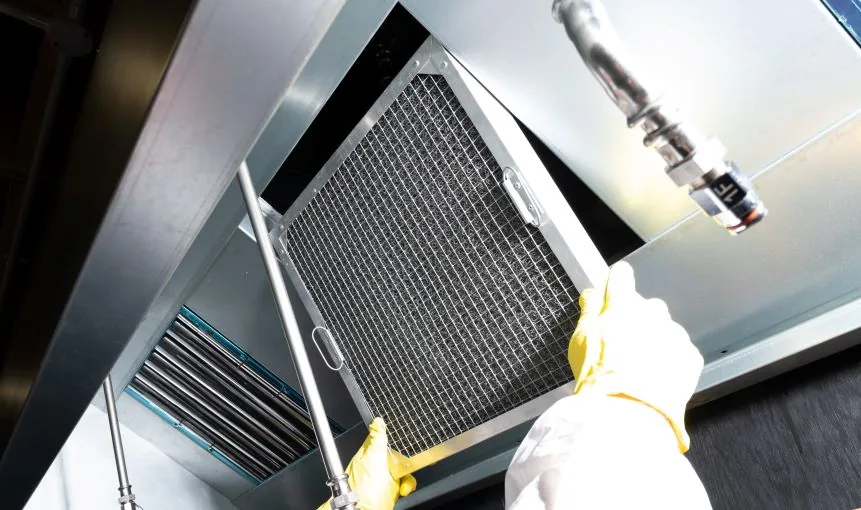
Mesh and baffle filters trap airborne grease before it reaches the duct. Saturated filters restrict airflow and let grease pass through.
With the filters out, the crew scrapes the hood interior, the grease trough, and the plenum cavity behind the filters, where thick, baked-on grease accumulates. The hood exterior gets degreased and polished too.
This is the core of the job and the part a general cleaner cannot do. The crew opens the duct access panels and cleans the duct interiors along the entire run, horizontal and vertical, with brushes and equipment sized for ductwork. Grease inside ductwork is the fuel for exhaust fires, and it is invisible from the kitchen floor. A crew that never opens your access panels never cleaned your ducts.
Up on the roof or the exterior wall, the exhaust fan gets cleaned: the wheel, the housing, and the surrounding surfaces. Grease on the fan unbalances it and strains the motor. Belts and general wear get a visual check while the crew is up there.
Everything comes back together: filters reinstalled, surfaces wiped and polished, sheeting removed, and the kitchen left as it was found. The crew powers the system back up and confirms it runs correctly before leaving.
That sequence is what "exhaust system cleaning" means. Anything less is a hood wipe-down with a fancier name.
Your kitchen crew has a real role in exhaust maintenance, and doing it well stretches the time between professional visits. But the line between staff work and professional work is a safety line, not a suggestion.
Get a free quote for professional exhaust cleaning. Tell us about your hoods and ductwork and we will give you a clear price and schedule.
Your staff can and should:
Leave to a professional crew:
The original version of this article gave do-it-yourself steps for the whole system. We removed them: the parts that matter most for fire safety are exactly the parts no untrained person should open up.
There is no single right schedule. NFPA 96, the National Fire Protection Association standard for commercial cooking ventilation and fire protection, sets cleaning frequency by what and how much a kitchen cooks, not by building size. Florida fire officials enforce exhaust cleanliness under the state fire code, which references NFPA 96. The schedule:
When in doubt, take the shorter interval. Your local fire marshal has the final word.
Florida adds its own pressure. Humid air keeps grease tacky instead of drying it out, high tourist-season volume pushes kitchens harder for months, and fire marshals here inspect exhaust systems as a matter of routine. If your kitchen runs heavy volume from winter through spring, plan professional cleanings around that calendar, not a generic annual reminder.
Any one of these means calling for a visit now, not at the next scheduled date.
The costs of postponing show up fast:
Before you book, ask these questions:
Florida Kitchen Pros is based in Dade City and serves commercial kitchens across the state. If your exhaust system is due, or overdue, call (727) 507-1735 or request a free quote and we will put your kitchen on a proper cleaning schedule.
A typical single-hood kitchen takes a few hours. Multiple hoods, long duct runs, or heavy buildup take longer. A reputable company works during your off hours so service is never interrupted.
Staff can handle filter rotation, hood wipe-downs, and grease cup emptying. Ductwork, the plenum, and the exhaust fan belong to trained professionals. The hidden grease is the dangerous grease.
It depends on the number of hoods, the length and condition of the ductwork, and how heavy the buildup is. Any honest quote comes after seeing the system or hearing the details of your kitchen. Be cautious of flat-rate quotes given sight unseen.
Fire marshals and health inspectors check exhaust cleanliness on routine visits, and neglected grease is a common write-up. A system on a documented cleaning schedule is in far better shape at inspection time.
Fuel type and cooking volume decide: solid fuel monthly, high-volume quarterly, moderate semi-annual, low volume annual. Between categories, ask your cleaning company or fire marshal to confirm the right interval.
Your exhaust system is the hardest-working safety equipment in your kitchen, and the easiest to ignore because the grease hides inside the ducts. If it has been longer than your cleaning interval, or you are seeing any of the warning signs above, now is the time. Call Florida Kitchen Pros at (727) 507-1735 or get a free quote online. We clean the full system, cooking line to rooftop, for commercial kitchens across Florida.
Florida Kitchen Pros is based in Dade City and serves commercial kitchens across Florida. Call now or request your free quote online and we will take it from there.